PM Surya Ghar 2.0: Latest Updates, Proposed Changes, Subsidy & Eligibility for Homeowners in 2026
Indias rooftop sector is moving into a key phase. The PM Surya Ghar: Muft Bijli Yojana has motivated millions of households to install rooftop lower their electricity bills and produce their own power.
Now talks about a next phase called PM Surya Ghar 2.0 are drawing interest from homeowners and the solar industry.
The proposed changes could give emphasis to real electricity production, battery storage, solar system performance and long‑term maintenance. However homeowners need to know which developments are officially confirmed and which remain in discussion.
In this guide we cover the reported PM Surya Ghar 2.0 updates, the current rooftop solar subsidy, eligibility rules, key scheme provisions and why homeowners should finish their solar installation before March 2027.
1. What Is PM Surya Ghar 2.0?
PM Surya Ghar 2.0 is a term used to describe a possible next phase or redesign of the existing PM Surya Ghar: Muft Bijli Yojana.
The original scheme was launched by the Government of India in February 2024 with a financial outlay of ₹75,021 crore. Its goal is to support rooftop installations in one crore residential households across the country.
In July 2026 the Ministry of New and Renewable Energy (MNRE) reportedly held talks with industry representatives and other stakeholders about the direction of the programme.
Some of the ideas reported include linking assistance to electricity generation encouraging battery storage improving system performance monitoring and strengthening long‑term maintenance.
Important:
PM Surya Ghar 2.0 has not been officially launched as a scheme as of November 2026. The existing programme continues to operate under the name PM Surya Ghar: Muft Bijli Yojana. Any proposed changes should be treated as discussions until MNRE publishes guidelines.
Where Does the Scheme Stand Today?
The existing PM Surya Ghar scheme is approved for implementation until the end of the financial year 2026–27.
According to a government update dated November 2026:
- More than 65.26 lakh households were benefiting from rooftop solar installations as of 2 November 2026.
- Approximately ₹35,800 crore in subsidy had been transferred to beneficiaries.
- Nearly 21 lakh households had received zero electricity bills in at least some billing periods up to October 2026.
- Around 19.1 GW of rooftop solar capacity had been commissioned under the scheme.
These figures show the growing use of rooftop solar in India and the importance of the scheme for homeowners.
2. What Could Change Under PM Surya Ghar 2.0?
The reported proposals for PM Surya Ghar 2.0 suggest a shift from focusing mainly on installed solar capacity towards the real performance of rooftop solar systems.
- Generation-Based Financial Assistance
Under the existing scheme eligible homeowners receive Central Financial Assistance (CFA) based on the installed capacity of their solar system.
One of the reported proposals for PM Surya Ghar 2.0 is to link a portion of assistance to the actual electricity generated by the solar system.
If introduced this approach could give importance to the energy produced by an installation rather than only the number of kilowatts installed.
For homeowners factors such as system design, solar panel selection, installation quality, sunlight availability and regular maintenance could become even more important.
Current status: Generation-linked financial assistance is a reported proposal. No revised household subsidy structure has been officially notified.
- Possible Battery Storage Support
Battery storage is another area receiving attention in discussions about the phase of the scheme.
A rooftop solar system generally generates electricity during daylight hours. Without battery storage unused solar electricity may be exported to the grid subject to net‑metering arrangements.
A battery system can store solar energy for use later depending on the system configuration and household consumption.
If battery‑related support is introduced under a version of the scheme it could make solar‑plus‑storage systems more attractive to homeowners who want to use more of their own generated electricity.
Current status: A separate household battery subsidy has not been announced under the existing CFA structure. Any future battery support remains unconfirmed.
- Improved Solar System Monitoring
Another reported idea is to introduce a record or solar passport, for rooftop installations.
A system like this could keep track of details such as:
- Solar electricity generation.
- System performance history.
- Equipment and installation details.
- Maintenance and service records.
- Product warranty information.
Current status: A digital solar passport is a reported concept, not a confirmed requirement under the existing scheme.
- Greater Focus on Installation Quality and Maintenance
The long‑term performance of a solar system depends on more than just how many watts it can produce.
The quality of panels the choice of inverters, electrical protection, how the system is installed its design and how it is kept up all affect how much power the system makes and how reliable it is.
If the proposed performance‑focused plan is used the quality of installation and the service that follows will become more important.
For homeowners picking a solar installer and making sure the system is designed for the real electricity needs will still be key.
Current status: More focus on performance and service has been talked about for a redesign but no new rules have been announced yet.
Existing Scheme vs Possible PM Surya Ghar 2.0 Changes
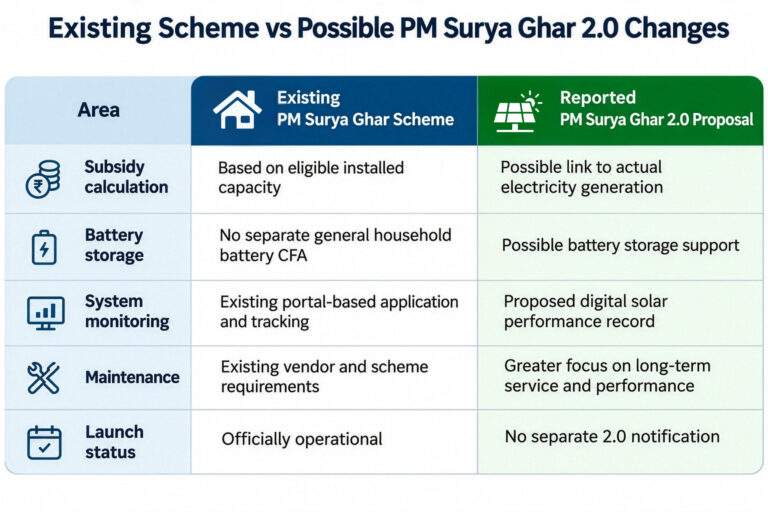
These proposed changes should not be considered confirmed benefits until official MNRE guidelines are released.
3. PM Surya Ghar 2.0 Subsidy: What Homeowners Can Get Today
A common search about PM Surya Ghar 2.0 is about the solar subsidy amount.
Now there is no separate subsidy amount announced for PM Surya Ghar 2.0. Eligible homeowners can apply under the current PM Surya Ghar: Muft Bijli Yojana and its guidelines.
Current Rooftop Solar Subsidy for Individual Homes
For general‑category states the current central financial help structure is:
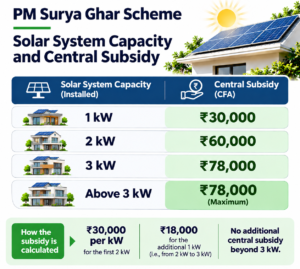
The subsidy calculation is:
- ₹30,000 per kW for the first 2 kW.
- ₹18,000 for the additional 1 kW.
- Maximum central subsidy of ₹78,000 for systems of 3 kW and above.
For example if a homeowner installs a 5 kW rooftop system under the general‑category rules that homeowner will get the same maximum central subsidy of ₹78,000 as a 3 kW system.
The subsidy that a homeowner can claim goes into the homeowner’s bank account via Direct Benefit Transfer after the installation, inspection and commissioning are finished.
Note: Subsidy rates and eligibility can differ for special-category states and regions. Homeowners should check the applicable MNRE guidelines and National Portal before making an installation decision.
Will the Subsidy Increase Under PM Surya Ghar 2.0?
There is currently no officially announced increase or revised subsidy amount for individual homeowners under PM Surya Ghar 2.0.
The reported generation-linked model could change how financial assistance is calculated or released in the future. However, the actual amount, payment structure and eligibility conditions will depend on the final government guidelines.
Until then, homeowners should refer to the existing subsidy structure rather than relying on unofficial estimates.
4. PM Surya Ghar 2.0 Eligibility: Who Can Apply?
There is no eligibility list for PM Surya Ghar 2.0 right now because the next phase has not been officially announced.
Homeowners can still apply under the current PM Surya Ghar: Muft Bijli Yojana long as they meet the scheme’s eligibility rules.
Eligibility Under the Existing Scheme
Individual residential consumers generally need to meet the following requirements:
- Have a valid residential electricity connection from the local electricity distribution company (DISCOM).
- Have suitable rooftop space for installing solar panels.
- Install the rooftop solar system through a vendor registered on the National Portal.
- Use eligible equipment that meets the applicable Domestic Content Requirement (DCR).
- Complete the application, installation, inspection and commissioning process through the prescribed scheme procedure.
Could Eligibility Rules Change Under PM Surya Ghar 2.0?
The reported discussions around the next phase include possible changes to the way rooftop solar support is designed and delivered.
However, no separate eligibility expansion or revised application procedure for individual homeowners has been officially announced.
Homeowners should therefore follow the current National Portal requirements and wait for formal MNRE notifications before assuming that new eligibility conditions will apply.
5. Important PM Surya Ghar Scheme Updates in 2026
While PM Surya Ghar 2.0 remains under discussion the existing scheme has introduced measures to make rooftop solar adoption easier for consumers.
Some important provisions highlighted by the Ministry of New and Renewable Energy include:
Easier Financing for Homeowners
Collateral-free loans are available through participating nationalised banks at a concessional interest rate of repo rate plus 50 basis points.
The government reported an interest rate of 5.75% per annum at the time of its July 2026 update, with a loan tenure of up to 10 years.
This can help eligible homeowners manage the initial investment required for rooftop solar installation.
Actual loan approval, interest rate and terms are subject to the participating bank’s applicable conditions.
Simplified Technical Approvals
The government has taken steps to simplify the approval process, including waiving the technical feasibility requirement and introducing automatic load enhancement up to 10 kW under applicable provisions.
These measures are intended to reduce delays and make residential rooftop solar installations easier.
Net Metering Process
The net-metering agreement has been integrated into the National Portal application process.
Net metering allows eligible homeowners to export excess electricity to the grid and receive applicable credits or adjustments according to the relevant state regulations and DISCOM rules.
The actual benefit depends on the applicable electricity regulations and the household’s consumption pattern.
Grievance Support
A grievance redressal mechanism has been established for the scheme.
The government has also reported that the consumer helpline number 15555 is operational in 12 languages to assist beneficiaries with scheme-related concerns.
Equipment Quality and Domestic Content Requirements
The scheme includes Domestic Content Requirement provisions for eligible rooftop solar installations.
Homeowners should ensure that the selected solar panels and other equipment meet the applicable scheme requirements. They should also verify that the installer is registered on the National Portal.
Following the prescribed equipment and installation requirements is important for completing the subsidy process successfully.
6. Should You Wait for PM Surya Ghar 2.0 Before Installing Solar?
Many homeowners are wondering whether they should install rooftop solar under the existing scheme or wait for PM Surya Ghar 2.0.
The answer depends on your electricity consumption, financial plans, rooftop conditions and expectations from a solar system.
However, there is currently no confirmed launch date, revised subsidy amount or final set of guidelines for PM Surya Ghar 2.0.
Here are a things to consider before making your decision.
- The Existing Subsidy Is Available
Eligible residential consumers can currently apply under the existing PM Surya Ghar scheme. Receive the applicable subsidy after completing the prescribed process.
There is no announcement that waiting will provide a higher subsidy.
- Consider Your Monthly Electricity Expenses
If your household has electricity consumption installing a properly designed rooftop solar system may help reduce the amount of electricity purchased from the grid.
Waiting for a policy change could mean continuing to pay your existing electricity bills in the meantime.
- Consider Battery Requirements Separately
If you need electricity backup during grid outages discuss your requirements with a solar installer.
A standard on‑grid solar system generally shuts down during a grid outage for safety reasons. A configured hybrid system with battery storage can provide backup depending on its design and capacity.
Do not assume that battery storage will receive a government subsidy, under PM Surya Ghar 2.0 until an official announcement is made.
- Check the Current Scheme Timeline
The existing PM Surya Ghar scheme is approved through FY 2026–27, which ends on 31 March 2027.
Homeowners planning to apply should check the latest portal instructions, complete the required process early and avoid assuming that a possible extension or new phase is guaranteed.
7. Why Homeowners Should Consider Installing Solar Before March 2027
With PM Surya Ghar 2.0 still awaiting official guidelines, homeowners should carefully consider the benefits available under the current PM Surya Ghar: Muft Bijli Yojana.
The existing scheme is approved until 31 March 2027, and there is currently no confirmed announcement regarding the launch date, revised subsidy structure or eligibility rules for the next version.
Waiting for PM Surya Ghar 2.0 could mean missing the opportunity to benefit from the current scheme within its approved implementation period.
Eligible homeowners planning to install rooftop solar should consider completing their application, installation, inspection and commissioning well before March 2027. This allows sufficient time for the installation and required subsidy procedures.
Under the current scheme, eligible residential consumers in general-category states can receive a central subsidy of up to ₹78,000, subject to the applicable guidelines.
Rather than waiting for an unannounced policy change, homeowners can evaluate the existing subsidy, understand their electricity requirements and plan their rooftop solar installation accordingly.
Don’t Wait for an Unconfirmed PM Surya Ghar 2.0 Update!
Planning to install solar at your home? Now is the time to explore the benefits of the existing PM Surya Ghar scheme.
At LightLeader, we help homeowners assess their electricity consumption, identify the right rooftop solar capacity and understand the government subsidy application process.
Our team can help you with:
- Residential rooftop solar consultation.
- Electricity bill and consumption assessment.
- Suitable solar system capacity selection.
- On-grid and hybrid solar solutions.
- Site assessment and installation planning.
- Guidance on the existing PM Surya Ghar subsidy process.
Get in touch with LightLeader today to schedule your free rooftop solar consultation and site assessment. Complete your solar installation well before March 2027 and make the most of the benefits currently available under PM Surya Ghar.
Frequently Asked Questions About PM Surya Ghar 2.0
Is PM Surya Ghar 2.0 officially launched?
No separate scheme called PM Surya Ghar 2.0 has been officially notified by MNRE as of November 2026. The term is being used to describe the reported next phase or possible redesign of the existing PM Surya Ghar: Muft Bijli Yojana.
What is the subsidy under PM Surya Ghar 2.0?
No separate subsidy amount has been announced for PM Surya Ghar 2.0. Under the existing PM Surya Ghar scheme eligible residential consumers in general‑category states can receive ₹30,000 per kW for the 2 kW and ₹18,000 for the next 1 kW subject to a maximum central subsidy of ₹78,000.
Will PM Surya Ghar 2.0 provide a generation‑based subsidy?
Generation‑linked financial assistance is one of the reported proposals being discussed for the phase. However MNRE has not officially announced a generation‑based subsidy structure.
Will homeowners get a battery subsidy under PM Surya Ghar 2.0?
Battery storage support has reportedly been discussed as a feature of the next phase. However no separate household battery subsidy has been officially announced under the existing CFA structure.
What is the last date for the PM Surya Ghar scheme?
The existing PM Surya Ghar scheme is approved through FY 2026–27, which ends on 31 March 2027. Homeowners should check the National Portal for the application and implementation instructions and plan their installation well in advance.
Who is eligible for the PM Surya Ghar subsidy?
Eligible residential consumers with a grid‑connected electricity connection from their DISCOM can apply through the National Portal, subject to the schemes conditions, equipment requirements and prescribed installation process.
Can I install a 5 kW system and receive ₹78,000 subsidy?
Under the applicable general‑category subsidy structure eligible residential consumers installing a 5 kW system can receive a maximum central subsidy of ₹78,000 subject to the schemes conditions. The subsidy does not increase beyond the 3 kW limit.
Should I install solar before March 2027?
Homeowners considering rooftop should evaluate the current PM Surya Ghar scheme rather than waiting for an unannounced next phase. The existing scheme is approved through 31 March 2027. There is no confirmed PM Surya Ghar 2.0 launch date or revised subsidy structure. Plan your application and installation early allowing time, for commissioning and the required verification process.
Where can I check official PM Surya Ghar updates?
Homeowners should visit the National Portal at https://pmsuryaghar.gov.in/ and the Ministry of New and Renewable Energy website at https://mnre.gov.in/ to find scheme guidelines, notifications and confirmed updates.
Make the Most of the Current PM Surya Ghar Scheme
PM Surya Ghar 2.0 may bring important changes to India’s residential rooftop solar programme. These changes could affect electricity generation, battery storage, system monitoring and long‑term performance.
These developments are only reported proposals. They should not be treated as confirmed government benefits.
The existing PM Surya Ghar: Muft Bijli Yojana still offers assistance to eligible residential consumers. The maximum central subsidy is ₹78,000 under the general‑category structure.
The current scheme is approved until 31 March 2027. There is no confirmed launch date or revised benefits for PM Surya Ghar 2.0. Homeowners should plan their rooftop installation well in advance.
A designed solar system can lower household electricity expenses. It can also make use of available rooftop space.